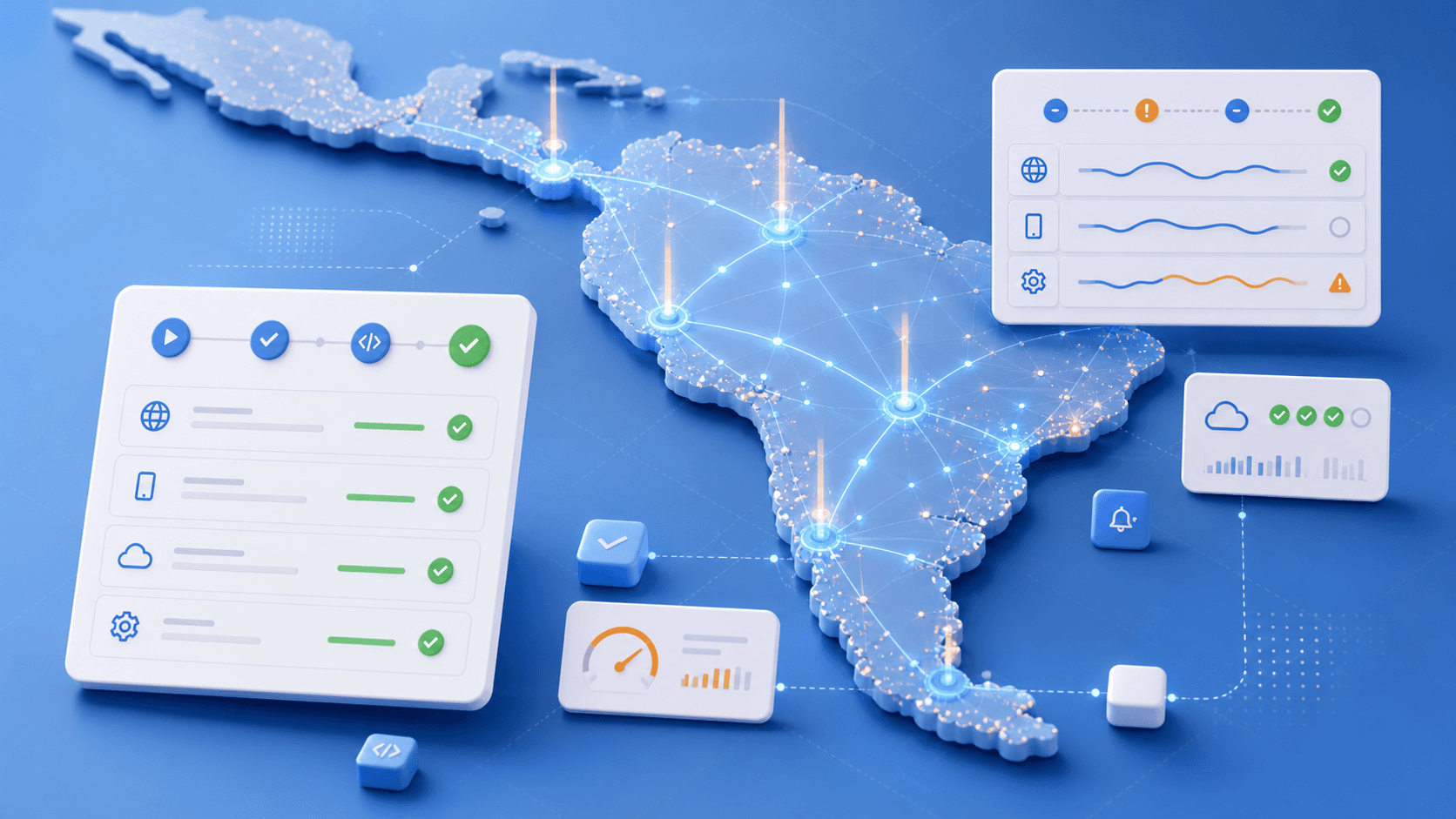

Tricentis validated the pain LATAM teams already feel
Tricentis reported that 75% of organizations in Latin America do not perform all necessary software tests, and that 70% experience delays or cost increases because of insufficient test coverage.
For teams building software in Bogotá, Medellín, São Paulo, Lima, Buenos Aires, Santiago, and the rest of the region, that should not sound surprising. QA work is often trapped between fast release pressure, limited automation capacity, uneven infrastructure, and tools priced for enterprise buyers.
The point is not that LATAM teams do not care about quality. The point is that many teams have never had a practical QA operating layer that matches their budget, team size, and release cadence.
Enterprise testing platforms do not solve the whole market
Tricentis expanding in Latin America is a strong signal that software quality in the region is becoming a board-level issue. Enterprise teams need governance, portfolio visibility, compliance workflows, and large-scale transformation programs.
But most LATAM startups, scale-ups, agencies, and mid-market product teams cannot buy or implement enterprise testing platforms as their first step. They need a smaller, faster path from manual regression to trustworthy automation.
That path starts with the release flows that already hurt when they break: login, checkout, onboarding, payments, document uploads, search, billing, permissions, and key API integrations.
What LATAM teams need instead
The practical solution is not another dashboard that assumes automation already exists. The practical solution is a way to create, run, debug, and monitor critical checks without requiring a large QA automation department.
For most teams, that means browser automation, API validation, scheduled synthetic checks, failure alerts, evidence capture, and rollback when a published test workflow breaks after a deploy.
- Browser and API automation in the same workflow
- Playwright import for teams that already have specs
- Visual workflow editing for QA ownership without constant dev tickets
- Scheduled synthetic checks for production-critical journeys
- Email and in-app alerts when failures happen
- Version history with one-click rollback for published workflows
- Transparent pricing that lets teams start before they become enterprise buyers
Network reality matters in Latin America
LATAM software quality is not only about whether a button works on a developer laptop. It is also about how the product behaves across variable mobile networks, regional latency, unstable office connections, and infrastructure differences between countries and cities.
A user in São Paulo on a strong fiber connection, a support agent in Bogotá behind a corporate proxy, a buyer in Lima on mobile data, and an operations team in Buenos Aires during peak traffic can experience the same product very differently.
That is why Tynkr's Network Matrix matters for LATAM teams. Teams can test critical flows under realistic regional profiles instead of assuming that a clean CI environment represents production users.
The Tynkr operating model
Tynkr gives teams a practical QA automation layer that sits above Playwright and API checks. The goal is not to replace engineering discipline. The goal is to make quality signals visible, repeatable, and fast enough for modern release cycles.
A QA lead can import existing Playwright specs, build new visual workflows, combine browser and API steps, schedule production checks, receive alerts, and share evidence with engineering without asking everyone to read CI logs.
For teams migrating from Microsoft Playwright Testing or consolidating browser checks after a platform change, Tynkr also provides a dedicated migration path: https://www.tynkr.co/migrate-from-microsoft-playwright-testing.
A practical rollout plan for startups and agencies
The first implementation should be small. Pick five flows that customers or revenue depend on, automate those, and run them on every deployment or every hour in production. Do not start by trying to automate the entire backlog.
Once the first flows are stable, add API checks around the integrations that break most often, then add Network Matrix coverage for the regions where customers actually operate. That sequence builds trust before expanding scope.
- Week 1: automate login, core conversion, billing, and one critical integration
- Week 2: configure scheduled checks, alerts, and evidence review
- Week 3: add API checks and regional network profiles
- Week 4: track pass rate, flake rate, MTTR, and escaped defects
What to measure
The best LATAM QA automation program is not the one with the most scripts. It is the one that reduces release risk with the least operational drag.
Measure whether failures are caught before customers report them, whether evidence is enough to debug without reproduction, whether alerts reach the right owner, and whether the team can keep automation current as the product changes.
That is the gap Tynkr is designed to close for the rest of the market: practical browser and API automation with evidence, alerts, network-aware checks, and pricing that lets teams start before they need an enterprise transformation program.