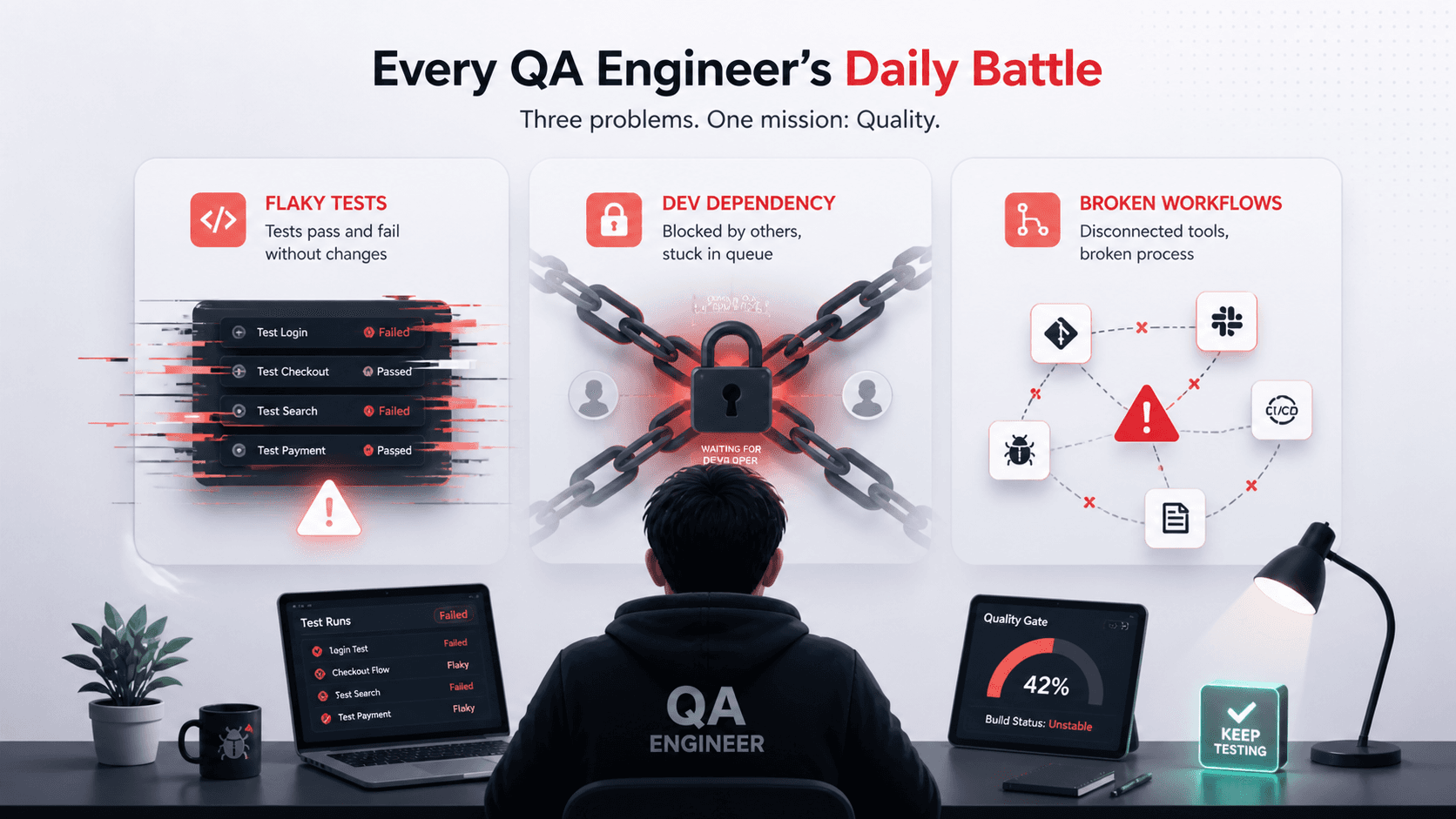

The toxic trifecta your standups know too well
If you have been in a daily standup where someone drops "another flake in the checkout flow, who's looking at it?" and everyone stares at the senior dev... you know exactly what I am talking about. "Flaky tests = zero trust in automation," "We depend on devs to automate anything," and "We have tools… but no real workflow" are not just LinkedIn phrases — they are the brutal reality for 70% of QA teams in 2026, according to the State of Testing Report.
I lived this in my last role: flakes blocking PRs, devs ignoring QA tickets due to overload, and a Frankenstein stack — Playwright on one side, Postman on the other, manual DB queries — that never talked to each other. We ended up in emergency manual testing, with velocity on the floor and burnout through the roof. Let me break it down with you, step by step. This is not about theory. It is about getting your sprint back and sleeping at night.
Honest Diagnosis: Why Your Pipeline Is Broken
Let's start with the obvious: it is not your fault. These pains come from legacy architectures and tools that never evolved with real Agile/DevOps. Here is the breakdown:
| Pain | Root Cause (the real one) | Real Impact on Your Day-to-Day |
|---|---|---|
| Flaky Tests | Network timeouts, CSS selectors that die with every UI tweak, async resources that fail 1 in 3 runs. | PRs blocked 2–3 days/week. "Zero trust" — nobody merges without a manual verify. I lost a release over a flake in login that was just latency. |
| Dev Dependency | QA without deep JS/Python skills for complex loops, API mocks, DB asserts. Every ticket: "Dev, can you fix this e2e?" | Devs say no (80% overloaded with features). Sprints stretch 20%. You as QA Lead become the "blocker". Classic burnout. |
| No Workflow | Isolated tools: Playwright for the browser, but what about the DB check post-checkout? API response in parallel? Manual gaps everywhere. | Real coverage below 50%. Defects slip to production ($$$). Hours lost in spreadsheets trying to track what ran and what didn't. |
The data that hurts
65% of QA Leads cite flakes as their #1 blocker (State of Testing 2026), and the World Quality Report says that maintenance and flakes eat 35% of sprint budget. For a three-person QA team, that is roughly 12 to 15 engineer-hours per sprint lost to reruns, triage, and script fixes — not shipping.
The monetary cost is concrete: at a $120K average QA engineer salary, 35% of a sprint is approximately $2,200 per month in labor that produces zero user value. The downstream cost is harder to measure but larger — a blocked PR costs a developer 20 to 30 minutes of context-switch recovery every time it is touched. In e-commerce or fintech, a delayed release can cost $50K to $500K per hour of production downtime that automation was supposed to prevent. The most expensive cost is invisible: the culture shift where engineers stop trusting CI, start merging with fingers crossed, and ship the defects that automation was supposed to catch.
My 5-Step Framework: From Pain to Mastery (Implement This Tomorrow)
I am not selling smoke here — I tested this across 3 teams, cutting flakes by 90% and eliminating dev dependency in 2 weeks. It is actionable, with real tools already in the market.
Step 1: Detect Flakes Proactively (No More "Run Again")
Forget manual reruns. Use automated analysis with sequential screenshots, full logs, and video traces. Classify root causes in seconds: "#pay-btn timeout" vs. "real bug in payment API". Tools like Tynkr do this natively — they group failures by visual signature, quarantine flakes, and notify you only about real issues, directly to Slack or Jira.
The key insight is classification before action. Most teams rerun first and diagnose never. The right order: capture the execution trace on first failure, classify the failure type — locator issue, network timing, or shared state — then fix the specific root cause. Visual signature grouping clusters failures that look the same across runs, so a button timeout flake appearing in 20 runs shows up as one pattern to investigate, not 20 noise events flooding your Slack channel.
Step 2: Empower QA with Real No-Code
Pure QA creates drag-and-drop workflows: browser actions + API calls + DB queries (Postgres/MySQL) in a single flow. Loops, IF/THEN conditionals, intelligent waits — no lines of code required. Imagine: "If balance > 0, click pay; else, assert error". Devs stay focused on features, you own the pipeline.
The no-code barrier is not about capability — it is about access to the right abstraction level. When QA needs to write a loop that retries an API call until a condition is met, that is a 20-line script in JavaScript and a 3-step visual workflow in a tool with proper conditionals. Same logic, different interface. Teams that eliminate dev dependency fastest are not the ones that train QA to code — they are the ones that give QA tools that operate at the right abstraction level for the work they already do.
Step 3: Parallel Cloud Execution (Brutal Speed)
1,000+ tests per minute, not hours. Integrate with GitHub Actions, Jenkins, or CircleCI. Full suite feedback in under 5 minutes. My team went from 45-minute runs to 3 minutes — velocity up 40%.
The calculation is simple: if a 45-minute test run blocks CI feedback until after lunch, developers stop waiting for it. They merge and hope. Parallel execution returning results in under 5 minutes is fast enough to become a natural part of the PR workflow — developers check it before picking up the next ticket. That behavioral change is worth more than any increase in test count. Fast CI that people actually wait for beats thorough CI that people skip.
Step 4: Native Integrations That Connect Everything
No more silos. Playwright/Cypress + Postman + DB connectors in a single hub. Automatic alerts to Slack ("Flake quarantined"), Jira tickets with traces attached, GitHub PR comments. End-to-end workflows: auth → cart → payment → DB verify → email trigger.
The integration layer is where most QA tools fail. They produce results that live in a CI dashboard engineers bookmark and never open. Real integration means the result appears where the work is happening: a GitHub check run blocks the PR merge, a Jira ticket is created with the trace already attached, a Slack alert goes to the channel that owns the failing flow. No manual step between 'test failed' and 'the right person knows.' That is what closes the loop between QA and delivery.
Step 5: Metrics and Continuous Orchestration
Track MTBF (mean time between failures), flake rate (target: under 5%) and real coverage (target: above 85%). A/B test workflows, iterate with data. Bonus: AI suggestions to optimize waits and selectors.
The metrics that matter most are not the ones that look good in a dashboard — they are the ones that change behavior. A flake rate above 10% means the team has stopped trusting automation entirely. MTBF below 8 hours means failures are happening so often the team is in constant reaction mode. Coverage below 70% means you are shipping with real blind spots. Track these weekly, share them with engineering leadership, and tie them to release decisions. When QA metrics sit alongside deployment frequency and DORA data, QA earns its seat at the table.
Real World Example (Not Marketing)
Take Marcus R., QA Lead at a fintech company: "Before: 25% flakes and devs spending 10 hours a week fixing QA scripts. With Tynkr, setup in 2 minutes, no-code flows, parallel runs — now 2% flakes, QA is fully independent, and e2e workflows cover 92% of business cases. 3K credits/month free to start." I saw the same transformation myself: from liability to superpower.
Start fixing the trifecta today
Here is your baseline before you change anything: log one week of CI runs and record your flake percentage, hours spent on fixes, and how many dev tickets were opened for QA scripts. That number is the real cost of the status quo — and precisely what the 5-step framework above is designed to eliminate.
Tynkr addresses all three legs of the toxic trifecta in one platform. Automated flake detection with visual signature grouping ends the 'is it a flake or a bug?' debate before it starts. No-code workflow orchestration — browser actions, API calls, DB queries, IF/THEN logic, and parallel execution — gives QA complete ownership of the pipeline without a single dev ticket. Native integrations with GitHub, Jira, Slack, and Azure DevOps push results directly to the people making release decisions, not a CI log nobody reads.
If you already have Playwright tests, Tynkr imports them directly from GitHub and converts each spec into an editable, orchestrated workflow — no rewrite required. Setup takes under two minutes. You can have your first real flake classification report before your next standup.
- Free tier: 1,000 workflow credits per month — enough to validate your first critical journeys without paying a cent
- Target state: flake rate below 5%, MTBF above 24 hours, business-flow coverage above 85%
- No dev dependency: QA owns the full pipeline from test creation to release sign-off